


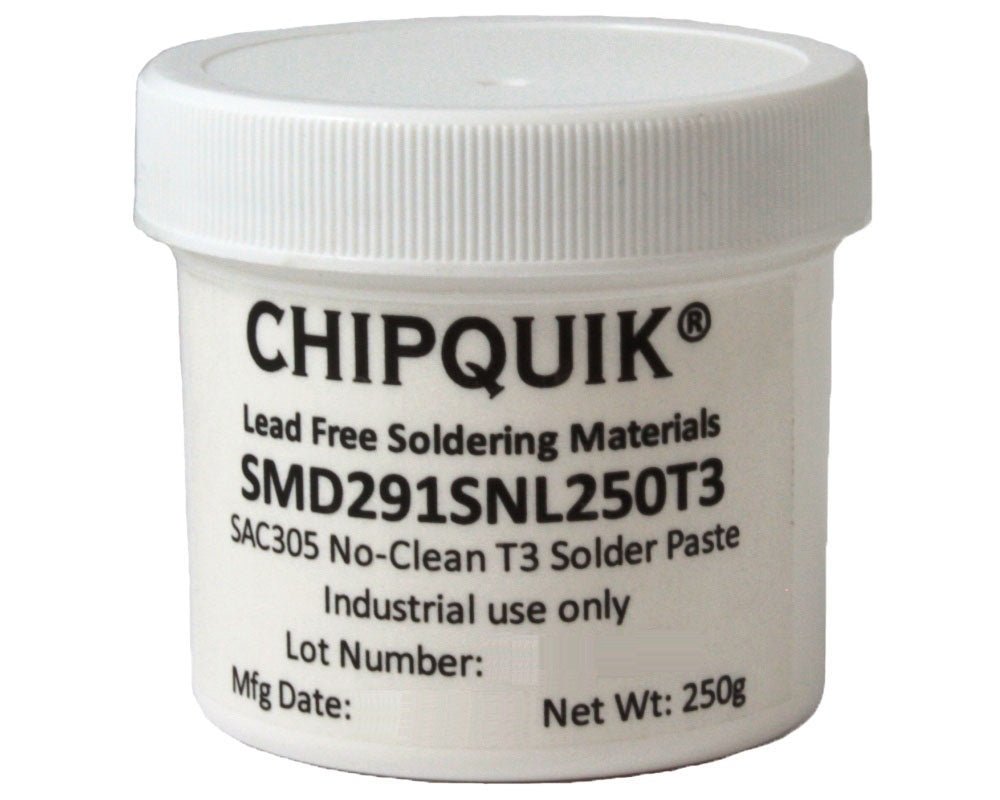
Chip Quik SMD291SNL250T3, Solder Paste in Jar, 250g (T3) SAC305, No Clean
Chip Quik SMD291SNL250T3, Solder Paste in Jar, 250g (T3) SAC305, No Clean
Chip Quik SMD291SNL250T3 is a print-grade SAC305 no-clean solder paste in a 250g jar. It combines Type 3 powder, synthetic REL0 flux, and 88.5% metal loading by weight. Use it for compatible stencil-printing processes where a smaller jar format is appropriate, and validate the complete printing and reflow process before production.
Best Uses / Applications
For prototype, low-volume, and production SMT assembly using compatible stencil geometry and SAC305 reflow conditions. The manufacturer describes compatibility with enclosed print heads, clear residue, low voiding, and wetting on most board finishes. These capabilities require application trials and do not establish compatibility with every board or component.
Key Features
- Lead-free SAC305 alloy: Sn96.5/Ag3.0/Cu0.5.
- Type 3 powder, 25–45 µm, with 88.5% metal by weight.
- Synthetic no-clean REL0 flux.
- Print-grade 250g jar; manufacturer print-speed guidance of 25–100 mm/s.
- Humidity-dependent stencil-life guidance to support process planning.
Technical Specifications
| Part number | SMD291SNL250T3 |
|---|---|
| Manufacturer | Chip Quik |
| Alloy | SAC305, Sn96.5/Ag3.0/Cu0.5 |
| Powder size | Type 3, 25–45 µm |
| Flux | Synthetic no-clean, REL0 |
| Metal loading | 88.5% by weight |
| Melting range | 217–220°C; not the recommended oven peak |
| Package | 250g jar |
| Stencil life, manufacturer guidance | Greater than eight hours at 20–50% RH and 22–28°C; greater than four hours at 50–70% RH and 22–28°C |
| Storage | Refrigerate at 3–8°C; do not freeze |
| Warm-up guidance | Manufacturer specifies four hours to reach 20–25°C operating temperature before use; confirm material has equilibrated |
| Shelf-life guidance | Data sheet lists refrigerated greater than six months and unrefrigerated greater than two months, with additional manufacturer-specific shelf-life notes; review the complete applicable documentation and lot information |
Storage, Printing and Reflow
Keep material sealed during warm-up to limit condensation. Follow the manufacturer handling instructions; the data sheet describes stirring jar material for two to three minutes before inspection and use. Its shelf-life notes also discuss inspection and manufacturer warranty terms. Do not treat those notes as automatic permission to use expired material in a controlled production process.
Use automated stencil cleaning for stencils and misprinted boards where appropriate; the manufacturer also lists manual IPA cleaning. Validate the method, equipment compatibility, and complete removal of loose solder particles. The recommended reflow profile is a starting point for process optimization, not a universal oven recipe. Follow the SDS and applicable safety procedures.
Type 3 vs. Type 4 and Type 5
| Powder | Selection consideration |
|---|---|
| Type 3, this listing | 25–45 µm powder; select using the smallest stencil aperture and release performance. |
| Type 4 or Type 5 alternatives | Finer powder may suit smaller apertures, but has different surface-area and process considerations. Confirm the complete formulation. |
| Same alloy, different package | A matching SAC305 name does not establish identical flux, metal loading, or application method. |
Frequently Asked Questions
What does T3 mean?
It identifies Type 3 solder powder. This product's data sheet lists a 25–45 µm particle-size range.
Is this a dispensing syringe?
No. SMD291SNL250T3 is a 250g jar of print-grade paste. Select a separately specified dispensing product if your process requires one.
Does no-clean mean there is no residue?
No. The manufacturer describes clear residue. Determine whether it may remain from your qualified application requirements, and validate removal if needed.
How does humidity affect stencil life?
The manufacturer lists greater than eight hours at 20–50% RH versus greater than four hours at 50–70% RH, both at 22–28°C. Validate actual working time in your production environment.
Should the jar be frozen?
No. The manufacturer specifies refrigeration at 3–8°C and explicitly says not to freeze.
Is 217–220°C the correct oven peak?
No. That is the listed melting range. Use the manufacturer's reflow guidance and validate the measured assembly profile.
Related Resources
Compare solder pastes | Soldering, Desoldering & Rework guide
Technical reference: Chip Quik SMD291SNL250T3 manufacturer data sheet, revision 1.3. Technical and safety document download links are omitted pending Shopify-hosted copies.


