


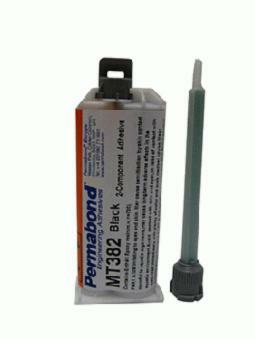
Permabond MT00382K050C0101, MT382 Modified 2 Part Epoxy, 50ml, Case of 25
Permabond MT00382K050C0101, MT382 Modified 2 Part Epoxy, 50ml, Case of 25
Permabond MT382 is a self-leveling, two-part modified epoxy for sealing, bonding, electronic potting, and encapsulation. It adheres to nylon, ABS, polycarbonate, other plastics, and a variety of metals. This MT00382K050C0101 listing is supplied as a case of 25 × 50 ml cartridges, with a static mixer included with each cartridge.
Best Uses / Applications
- Electronic potting and encapsulation where a self-leveling modified epoxy suits the assembly.
- Sealing and bonding applications involving compatible metals and plastics.
- Nylon, ABS, and polycarbonate assemblies requiring substrate-specific bond testing.
- Cartridge-dispensed industrial bonding where room-temperature cure is preferred.
Key Features
- Self-leveling formulation for potting and encapsulation.
- Full cure at room temperature; heat can accelerate cure.
- Typical elongation at break of 150–200%.
- Standard TDS mix ratio: 2:1 by volume, not 2:1 by weight.
- 20–50 minute usable life at 25°C; larger quantities and higher temperatures shorten pot life.
- Charcoal-black mixed appearance.
Technical Specifications
Typical guideline data from Permabond MT382 Global TDS Revision 19, dated November 16, 2021. These values are not a product acceptance specification.
| Property | Typical value / condition |
|---|---|
| Ordering code / grade | MT00382K050C0101 / MT382 |
| Package | 25 × 50 ml cartridges; static mixer included with each cartridge |
| Chemistry | Part A: epoxy resin; Part B: polyamine-based hardener |
| Appearance | Part A: black; Part B: yellow; mixed: charcoal black |
| Viscosity at 25°C | Part A: 32,000 mPa·s (cP); Part B: 300 mPa·s (cP) |
| Specific gravity | Part A: 1.3; Part B: 1.0 |
| Mix ratio | 2:1 by volume; 130:50 by weight |
| Maximum gap fill | 0.5 mm / 0.02 in |
| Usable / pot life at 25°C | 20–50 minutes |
| Handling time at 25°C | 105–120 minutes to 0.1 N/mm² |
| Full cure at 25°C | At least 72 hours |
| Hardness, ISO 868 | 55–85 Shore A; 20–30 Shore D |
| Elongation at break, ISO 37 | 150–200% |
| Aluminium peel strength, ISO 4578 | 140–160 N/25 mm / 31–36 PIW |
| Thermal conductivity | 0.47 W/(m·K) |
| Glass transition temperature | −35°C / −31°F |
| Linear thermal expansion | 112 × 10⁻⁶ m/m·°C below Tg; 170 × 10⁻⁶ m/m·°C above Tg |
| Dielectric constant at 23°C | 6* |
| Dielectric strength | 20–30 kV/mm* |
| Volume resistivity | Confirm directly from the source PDF or Permabond; the exponent is not reliably readable in the extracted document text. |
| Storage temperature | 5–25°C / 41–77°F |
*The TDS identifies its electrical values as typical of associated resin systems or extrapolated from other results. Validate electrical performance for the intended assembly. The stated 0.5 mm joint gap fill is not a maximum potting-pour depth.
Typical Lap Shear Strength by Substrate
ISO 4587 values vary with surface preparation and bond gap.
| Substrate | Typical shear strength |
|---|---|
| Mild steel | 4–7 N/mm² |
| Aluminium | 6–8 N/mm² |
| ABS | 4–6 N/mm² |
| Acrylic | 2–5 N/mm² |
| Nylon | 2–4 N/mm² |
| Polycarbonate | 4–6 N/mm² |
| PVC | 3–5 N/mm² |
| Glass-epoxy FRP | 5–7 N/mm² |
| Glass-polyester FRP | 5–7 N/mm² |
| Carbon fibre | 6–8 N/mm² |
Selection Comparison: Self-Leveling or Non-Sag Adhesive?
| Process need | MT382 self-leveling epoxy | Non-sag / thixotropic alternative |
|---|---|---|
| Flow | Designed to self-level in suitable contained applications. | Consider when the adhesive must stay in a bead or resist running. |
| Application | Potting, encapsulation, sealing, and bonding. | Consider for vertical or unsupported joints after verifying grade-specific properties. |
| Selection checks | Validate substrate adhesion, cure time, flexibility, gap, and dispensing requirements. No alternative is implied to be a drop-in replacement. | |
Surface Preparation & Directions for Use
- Make surfaces clean, dry, and grease-free. The TDS suggests a suitable solvent such as acetone or isopropanol; check substrate compatibility. Some metals benefit from light abrasion to remove oxide.
- For the standard TDS process, mix two parts resin to one part hardener by volume. For cartridges, use an appropriate dispensing gun and specified static mixer. Mix thoroughly without entrapping air.
- Apply the material. For potting, fill carefully to avoid trapped air. Join bonded parts within the 20–50 minute working window at 25°C.
- Clamp bonded assemblies for 105–120 minutes or until handling strength is obtained.
- Allow at least 72 hours at 25°C for full cure. Temperature and mixed quantity affect the working and curing times.
The TDS notes that other mix ratios can change cured flexibility. Do not change the ratio of a supplied cartridge or improvise an alternative process; obtain application-specific instructions from Permabond. Exercise caution with large mixed quantities because of exothermic heat. The product is not recommended in contact with strong oxidizers. Consult the SDS for safe handling. For professional or industrial use only; keep out of reach of children.
Manufacturer Technical Data Sheet
Download Permabond MT382 Technical Data Sheet, Revision 19 (PDF).
Permabond Manufacturer Videos
The MT382 TDS links these general instructional videos. They provide process guidance, not a substitute for the grade-specific data sheet.
Two-Part Epoxy Directions for Use
Watch two-part epoxy directions on YouTube.
Surface Preparation
Watch surface preparation on YouTube.
Frequently Asked Questions
What is MT382 used for?
Permabond specifies sealing, bonding, electronic potting, and encapsulation. The self-leveling formulation adheres to metals and plastics including nylon, ABS, and polycarbonate, subject to application testing.
Is its mix ratio 2:1 by weight?
No. The TDS specifies 2:1 by volume and 130:50 by weight. These are different measurements and should not be interchanged.
How quickly does it cure?
At 25°C, usable life is 20–50 minutes, handling time to 0.1 N/mm² is 105–120 minutes, and full cure requires at least 72 hours. Higher temperatures or larger mixed quantities shorten usable life.
Can it be used for electronic encapsulation?
Yes, that is a manufacturer-listed application. Avoid entrapped air and validate the cured material against the assembly's electrical, thermal, and mechanical requirements. The TDS qualifies its electrical values as typical or extrapolated.
Does the case include static mixers?
This listing specifies 25 × 50 ml cartridges with a static mixer included with each cartridge. Do not assume any other 50 ml nozzle is an approved replacement; verify the cartridge interface and mixing requirements.
Does the 0.5 mm gap-fill value limit potting depth?
The TDS lists 0.5 mm as maximum joint gap fill, not a maximum potting depth. Obtain guidance for large pours because mixed quantities can generate exothermic heat.
How should it be stored?
The TDS specifies 5–25°C (41–77°F). Consult the applicable SDS and packaging instructions; the supplied TDS does not state a shelf-life value.
Related Products & Resources
Explore the Permabond collection and the Adhesives, Dispensing & UV Cure Systems guide. For broader selection context, read Why Permabond Adhesives Deliver Unmatched Performance for Modern Manufacturing.


