

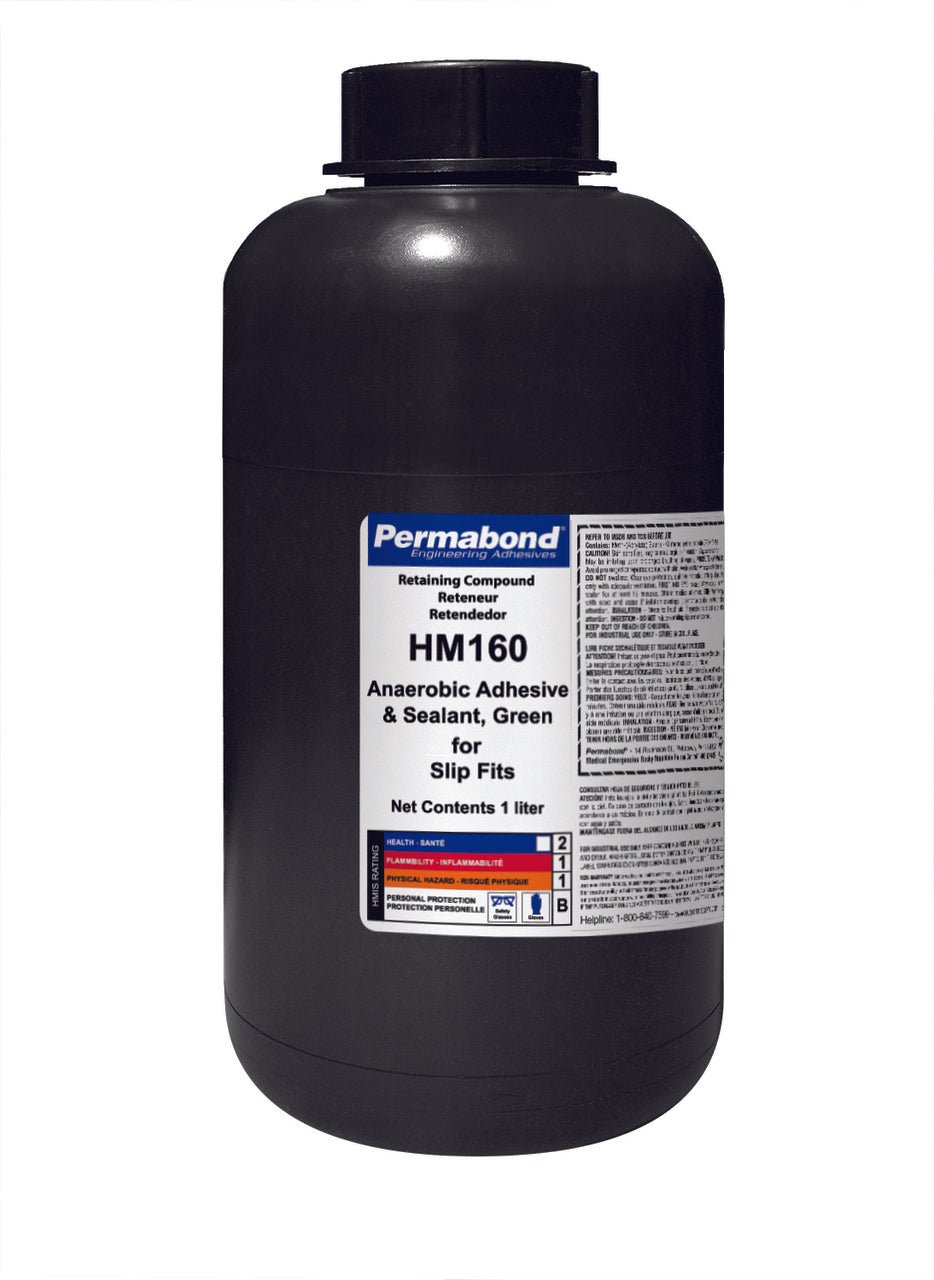
Permabond AA001600001L0101, HM160 Anaerobic Retaining Compound, 1 Liter Bottle, Case of 10
Permabond AA001600001L0101, HM160 Anaerobic Retaining Compound, 1 Liter Bottle, Case of 10
Permabond HM160 is a medium-viscosity anaerobic retaining compound that cures when confined between close-fitting metal parts, forming a tough, hard plastic that locks and seals the joint. The anaerobic cure mechanism delays cure to allow proper assembly and alignment. Once cured, HM160 prevents loosening from vibration and thermal expansion and seals the joint against harsh environments. Sold as a 1 liter bottle; case of 10.
Product Specifications
| Specification | Value |
|---|---|
| Part Number | AA001600001L0101 |
| Product Code | HM160 |
| Manufacturer | Permabond |
| Type | Anaerobic retaining compound |
| Viscosity | Medium viscosity liquid |
| Cure Mechanism | Anaerobic (cures in absence of oxygen, confined between metal parts) |
| Cured Form | Tough, hard plastic |
| Volume | 1 liter bottle |
| Case Quantity | 10 bottles per case |
Key Features & Benefits
- Anaerobic Cure — Cures only when confined between metal parts in the absence of oxygen — delays cure to allow proper assembly and alignment before locking
- Medium Viscosity — Liquid state wets metal surfaces, keys into surface irregularities, and fills the space between mated parts for complete coverage
- Vibration Resistance — Once cured, prevents loosening of press-fit and slip-fit assemblies from vibration
- Thermal Expansion Resistance — Fills and locks the joint against movement from thermal cycling
- Environmental Sealing — Seals the joint against attack by harsh environments, fluids, and corrosion
- Tough Cured Bond — Cures to a hard plastic for durable, long-lasting retention
Typical Applications
- Retaining cylindrical assemblies — bearings, bushings, sleeves, and shafts
- Locking press-fit and slip-fit metal assemblies
- Sealing joints against fluid ingress and corrosion
- Preventing loosening from vibration in industrial machinery
- Augmenting or replacing mechanical fasteners in metal assemblies
Frequently Asked Questions
How does anaerobic curing work?
Anaerobic adhesives cure in the absence of oxygen when confined between metal surfaces. In the open air, the adhesive remains liquid indefinitely. Once applied between close-fitting metal parts and the joint is assembled, oxygen is excluded and the cure begins. This gives the assembler time to position parts correctly before the adhesive locks.
What metal substrates is HM160 compatible with?
Anaerobic retaining compounds are designed for metal-to-metal assemblies. Active metals (steel, iron, copper alloys) cure faster; passive metals (stainless steel, aluminum, zinc) may require an activator for optimal cure speed. Refer to the Technical Data Sheet for substrate-specific guidance.
Can HM160 be used on loose-fitting assemblies?
HM160 is formulated for close-fitting cylindrical assemblies. For larger gaps or looser fits, a higher-viscosity or gap-filling anaerobic compound may be more appropriate. Contact MTE Solutions for guidance on selecting the right Permabond product for your application.
Is HM160 removable after cure?
Cured anaerobic retaining compounds are generally considered permanent. Disassembly typically requires heat (above 250°C) and mechanical force. Refer to the TDS for specific disassembly guidance.
What size does this come in?
This listing is for the 1 liter bottle (case of 10). Contact MTE Solutions for other Permabond HM160 package sizes.


