
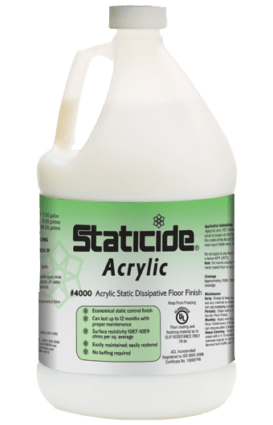
ACL Staticide 40001 Acrylic ESD Dissipative Floor Finish, 1-Gallon Containers, Case of 4
ACL Staticide 40001 Acrylic ESD Dissipative Floor Finish, 1-Gallon Containers, Case of 4
ACL Staticide 40001 is the gallon-case option of Staticide 4000 Acrylic Dissipative Floor Finish, a budget-conscious, water-based solution for static-control floor maintenance. This case contains four separate 1-gallon containers, providing a manageable format for distributing supplies across maintenance areas. Designed for VCT, linoleum and ceramic tile, the acrylic formula leaves a resilient, glossy finish and is especially useful for contract manufacturers and businesses operating in leased premises.
Best Uses / Applications
- Electronics repair facilities and contract manufacturing.
- Laboratories with facility-approved static-control floor requirements.
- Shipping and production areas.
- Static-sensitive warehousing and data centers.
- Distributed maintenance of compatible VCT, linoleum and ceramic tile floors.
Key Features
- Water-based acrylic formulation with a resilient, glossy finish.
- Electrostatic dissipative performance for compatible floor-care programs.
- UL-listed for slip resistance.
- Manufacturer states RoHS and REACH compliance, biodegradability and non-flammability.
- Free of formaldehyde, phthalates, alkalis and acids; consult the SDS for handling precautions.
- Made in USA.
- Four separate 1-gallon containers per case.
Technical Specifications
| Specification | Detail |
|---|---|
| Manufacturer / SKU | ACL Staticide / 40001 |
| Product family | Staticide 4000 Acrylic Dissipative Floor Finish |
| Package | 1-gallon containers, 4 per case; 4 gallons total |
| Formula | Water-based acrylic |
| Compatible flooring | VCT, linoleum and ceramic tile |
| Surface resistance | 10⁸–10⁹ ohms at 100 V and 12% RH |
| Coverage | Approximately 750–1,000 sq. ft. per gallon for two coats |
| Estimated case coverage | Approximately 3,000–4,000 sq. ft. for two coats, calculated from published per-gallon coverage; actual coverage varies with substrate and application |
| VOC | Less than 4% |
| Solids | 20% ±5% |
| Published strip cycle | 6–12 months |
| Slip resistance | UL listed |
| ESD suitability | Manufacturer states suitability for floor specifications outlined in ANSI/ESD S20.20 |
| Other manufacturer-stated attributes | RoHS and REACH compliant; biodegradable; non-flammable |
| Country of manufacture | USA |
Best-Use Practices
- Review ACL's current application instructions, TDS and SDS before preparing or coating the floor.
- Confirm compatibility with the floor manufacturer and evaluate a small area before broad application.
- Follow manufacturer directions for surface preparation, coat application, drying and ongoing maintenance; do not substitute assumed cure times.
- Keep personnel off treated areas until ready for use under the application instructions.
- Verify installed floor resistance and personnel-grounding performance as required by your ESD program. Product suitability does not certify a facility.
- Assess wear and measured performance to establish maintenance timing; the published strip cycle is not a guaranteed service life.
- Plan winter deliveries around ACL's freeze-sensitive shipping restrictions.
Acrylic Floor Finish Package Comparison
| SKU | Package | Selection consideration |
|---|---|---|
| 40001, this listing | 1-gallon containers, 4 per case | Separate containers for distributed maintenance |
| 40005 | 5-gallon pail | Larger maintenance jobs |
| 40002 | 54-gallon drum | Bulk facility maintenance |
Frequently Asked Questions
What does 40001 include?
Four separate 1-gallon containers of Staticide 4000 Acrylic Dissipative Floor Finish, totaling 4 gallons.
Which floors is it intended for?
ACL lists VCT, linoleum and ceramic tile. Confirm suitability for your specific floor before application.
How much area can a case cover?
ACL publishes approximately 750–1,000 sq. ft. per gallon for two coats. Four gallons gives an estimated 3,000–4,000 sq. ft.; actual coverage depends on application and substrate.
What is the surface resistance?
ACL reports 10⁸–10⁹ ohms at 100 V and 12% relative humidity. Measure the installed floor to verify performance in your facility.
Does this finish certify my facility to ANSI/ESD S20.20?
No. ACL states suitability for floor specifications outlined in the standard. Facility compliance depends on the complete ESD program, installed flooring, grounding and verification procedures.
How often should the floor be stripped?
The published strip cycle is 6–12 months. Actual maintenance timing depends on traffic, wear, condition and measured electrical performance.
How does Acrylic differ from Ultra II?
Staticide 4000 Acrylic is water-based and intended for VCT, linoleum and ceramic tile, with a 6–12 month strip cycle. Staticide 4800 Ultra II is urethane-enhanced for concrete, epoxy, ESD epoxy and dissipative tile, with a published 12–18 month strip cycle. Select by substrate and maintenance requirements rather than assuming interchangeability.
Is it slip-resistant and hazard-free?
ACL lists the finish as UL-listed for slip resistance and non-flammable. These attributes do not eliminate all slip or handling risks; follow the application instructions and SDS.
How does the case compare with 40005 and 40002?
All are package options for Staticide 4000 Acrylic Dissipative Floor Finish. 40001 has four 1-gallon containers, 40005 is a 5-gallon pail, and 40002 is a 54-gallon drum.
Are there winter shipping restrictions?
ACL warns of extended winter lead times due to limited freeze cycles. The manufacturer ships floor finishes and paint on Mondays and Tuesdays during winter and may halt shipments during extreme weather.
Related ESD Resources
Review ESD Program Essentials for program planning and browse the ACL Staticide collection for related static-control products.