

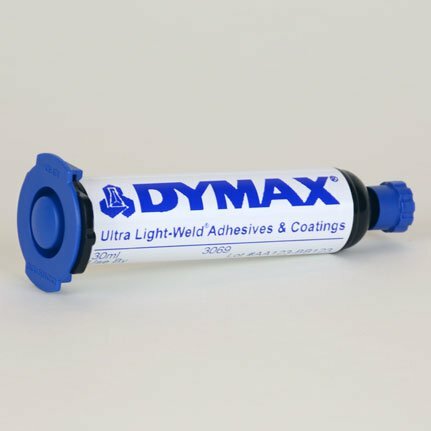
Dymax Ultra Light-Weld 3069 Flexible Laminating And Bonding Material 10Ml Syringe (Pack Of 10)
Dymax Ultra Light-Weld 3069 Flexible Laminating And Bonding Material 10Ml Syringe (Pack Of 10)
Dymax Ultra Light-Weld 3069, SKU 3069/10SYMR, is a flexible acrylated-urethane adhesive for rapid bonding and lamination of flexible and rigid plastic substrates. It cures upon exposure to suitable UV and visible light, allowing positioning before light exposure and rapid processing once the assembly is illuminated. Recommended substrates include PVC, polycarbonate, polyurethane, PET, PETG and ABS.
The manufacturer reports that bond strength on polycarbonate and PVC usually exceeds substrate strength under its test conditions. That is not a guarantee for every resin grade or joint. Validate the actual parts, bond line and cure process.
Supplied as a pack of 10 × 10 ml syringes. Listed lead time: 1–2 weeks. The smaller syringe format can suit development work, lower-volume assembly or frequent changeovers; choose the format around the dispensing process and material consumption.
Best Uses / Applications
- Flexible lamination: evaluate bonding between flexible and rigid plastics where a flexible cured adhesive is desirable.
- Plastic housing assembly: consider joints with an adequate light path to the adhesive.
- Appliance assembly: assess adhesion and flexibility against the actual components and service exposures.
- Speaker assembly: a manufacturer-listed application requiring joint-specific mechanical and cure validation.
- Prototype and small-batch plastic assembly: the 10 ml syringe format can support controlled dispensing during process development.
Key Features
- UV/visible-light-curable acrylated urethane.
- Flexible cured material with typical 175% elongation at break.
- Nominal viscosity of 450 cP for this grade.
- Clear, translucent uncured liquid with no nonreactive solvents.
- Compatible with suitable spot, focused-beam or flood-curing processes, subject to qualification.
- Manufacturer-listed adhesion to a variety of plastics.
Technical Specifications
| Manufacturer / formulation | Dymax / Ultra Light-Weld 3069 |
|---|---|
| SKU | 3069/10SYMR |
| Syringe volume / pack | 10 ml per syringe / 10 syringes |
| Listed lead time | 1–2 weeks |
| Chemical class | Acrylated urethane |
| Cure method | UV and visible light |
| Uncured appearance | Clear, translucent liquid |
| Solvent content | No nonreactive solvents |
| Density | 1.02 g/ml, ASTM D1875 |
| Viscosity | 450 cP nominal, 20 rpm, ASTM D1084 |
| Durometer hardness | Shore D55, ASTM D2240 |
| Tensile at break | 17 MPa / 2,400 psi, ASTM D638 |
| Elongation at break | 175%, ASTM D638 |
| Modulus of elasticity | 170 MPa / 25,000 psi, ASTM D638 |
| Refractive index at 20°C | 1.51, ASTM D542 |
| Water absorption | 1.6% at 25°C for 24 hours, ASTM D570 |
| Boiling-water absorption | 2.9% after 2 hours, ASTM D570 |
| Linear shrinkage | 2.1%, ASTM D2566 |
| Glass transition temperature | 68°C, ASTM D5418; not a service-temperature rating |
| Storage | 10–32°C / 50–90°F, cool and dark, original unopened container |
| Shelf life | 18 months from manufacture at recommended storage conditions; not remaining shelf life at delivery |
| Data-sheet revision | February 10, 2023; technical data collected prior to 2008 |
These are manufacturer-reported typical properties, not specifications or guarantees of performance in a particular assembly. Select and qualify the complete bonding process before production release.
Curing and Handling Guidance
The data sheet lists example fixture times of 1 second with a 2000-EC at 50 mW/cm², 1 second with a 5000-EC at 200 mW/cm², and 0.4 seconds with a BlueWave 200 at 10 W/cm². These are equipment- and test-specific fixture results, not universal full-cure times. Dymax notes that actual cure time is typically 3–5 times fixture time, but requires full cure to be determined empirically for the application.
Cure depends on lamp spectrum and intensity, distance, bond gap, required cure depth and substrate light transmission. Do not assume a UV LED or other lamp is compatible solely because it emits UV. Validate the source and light path through the actual assembly. Full cure is the point where additional exposure no longer improves the measured cured properties.
- Keep bond surfaces clean and free of grease, mold release and other contamination.
- Minimize exposure to ambient and artificial light before intended curing.
- Use dispensing needles and fluid lines that are 100% light-blocking, not merely UV-blocking.
- Account for oxygen inhibition at exposed surfaces; use manufacturer guidance when a dry surface cure is required.
- Allow parts to cool after curing before testing or loading.
- Evaluate molded-in stress and stress cracking on representative plastic parts.
- Follow the safety data sheet and provide appropriate curing-area exhaust and light protection.
Selection Comparison
| Selection question | 3069 guidance |
|---|---|
| Flexible plastic lamination or housing assembly | 3069 is designed for these application types. Validate adhesion and flexibility on the actual substrate grades. |
| Opaque or shadowed joint | UV/visible light must reach the adhesive sufficiently. Do not assume unilluminated regions will cure; compare another process if access is inadequate. |
| Different dispensing or flow requirements | The nominal viscosity here is 450 cP. Confirm the exact formulation and viscosity variant rather than treating all related grades as interchangeable. |
| 10 ml versus 30 ml syringe | Compare consumption, changeovers and dispenser compatibility. This listing is specifically 3069/10SYMR, 10 ml syringes, pack of 10. |
| Room-temperature epoxy or cyanoacrylate alternative | Compare cure mechanism, light access, working window, joint gap and service requirements rather than choosing on cure speed alone. |
Frequently Asked Questions
Does 3069 cure with UV or visible light?
Both. The product data sheet specifies UV/visible-light cure. The source spectrum, intensity and light reaching the bond line must be appropriate; a lamp labeled UV is not automatically a validated match.
Which plastics are recommended?
Dymax lists PC, PVC, PET, PETG, PU and ABS as recommended substrates. Resin grades, additives and molded-in stresses vary, so qualify the actual production parts.
Does a 0.4-second fixture time mean full cure?
No. That is a specific BlueWave 200 fixture result under the listed test conditions. Full cure requires application-specific evaluation of properties such as adhesion, hardness and surface condition as exposure is increased.
Can it cure inside an opaque or shadowed assembly?
Do not assume so. The adhesive requires suitable light exposure, and substrate light transmission affects cure. Establish an adequate light path or evaluate another adhesive system.
Why must dispensing components block visible light too?
3069 responds to visible as well as UV light. Dymax therefore calls for 100% light-blocking dispensing components, not only UV-blocking lines and needles, to minimize unintended curing.
Is the bond always stronger than the plastic?
No. Dymax reports that bond strength on PC and PVC usually exceeds substrate strength under its testing. Actual performance still depends on substrate grade, preparation, joint geometry and cure.
How should the material be stored?
Store in a cool, dark place at 10–32°C in the original unopened container, protected from light. The listed 18-month shelf life runs from manufacture under recommended conditions, not from the date of purchase.
Product Data Sheet
Download the Dymax 3069 product data sheet (PDF) for typical properties, equipment-specific curing examples, storage and handling guidance.
Related Adhesive Options
Explore Dymax adhesives or the broader Adhesives collection to compare formulations by substrate, flow, cure method and service requirements.


