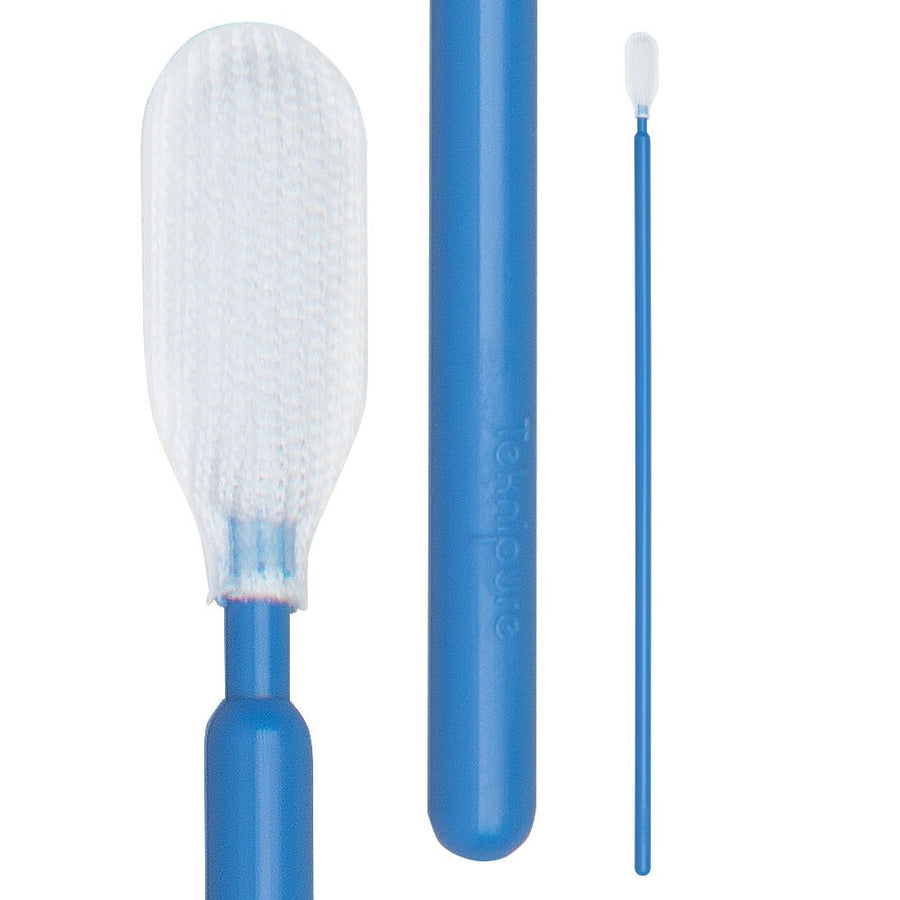



Teknipure TKS554P Polyester Medium Head Swab with Long Handle, 6.417" (16.30 cm), 1000 swabs/case
Teknipure TKS554P Polyester Medium Head Cleanroom Swab with Long Handle, 6.417 in (16.30 cm), Case of 1,000
The Teknipure TKS554P is a single-end medium head cleanroom swab with a 6.417" (16.30 cm) long handle, constructed from double-layer 100% polyester knit with a 100% polypropylene handle, rated for ISO Class 5–8 environments. The double-layer polyester knit tip provides ultra-low particle generation, ultra-low NVR, and excellent chemical resistance with aggressive solvents — making polyester the preferred tip material for optical surface cleaning, lens wiping, sensor cleaning, and precision component cleaning where contamination from the swab tip must be minimized. The medium head tip provides a larger contact surface than the rectangular TKS553P for greater surface coverage per swipe; the 6.417" long handle provides maximum reach into deep equipment cavities, process chambers, and tool interiors. Thermally bonded — no adhesives, silicone, or amides. Packaged in silicone-free bags. Lot and bar-coded for traceability. 5-year shelf life stored at ambient conditions (59–86°F / 15–30°C).
Sold in cases of 1,000 swabs (100/inner bag, 1 inner bag/outer bag, 10 outer bags/case).
Specifications
| SKU | TKS554P |
|---|---|
| Brand | Teknipure |
| Product Line | TekniSwab® Polyester |
| Tip Material | Double-layer 100% polyester knit, thermally bonded |
| Tip Geometry | Medium head, single end |
| Handle Material | 100% polypropylene |
| Overall Length | 6.417 in (16.30 cm) |
| Sterility | Non-sterile |
| Packaging | 100/inner bag, 1 inner bag/outer bag, 10 outer bags/case, 1,000 swabs/case |
| Cleanroom Rating | ISO Class 5–8 (Class 100–100,000) |
| Extractables | Ultra-low NVR, ultra-low ions and particles; no adhesives, silicone, or amides |
| Traceability | Lot and bar-coded |
| Shelf Life | 5 years from date of manufacture |
| Storage | Ambient conditions, 59–86°F (15–30°C) |
| Packaging | Silicone-free bags |
| Application | Optical surface cleaning, lens and sensor wiping, deep-reach precision component cleaning, solvent application/removal in hard-to-reach areas, streak-free surface cleaning |
| Industries | Semiconductor/microelectronics, aerospace/defense, medical device/optics, pharmaceutical/biologics, printing/graphics |
Frequently Asked Questions
When should I use the TKS554P (polyester, long handle) vs. the TKS529F (foam, long handle)?
Both are medium head long-handle swabs at 6.417" for deep-reach cleaning. Polyester (TKS554P) provides ultra-low particle generation, ultra-low NVR, and superior chemical resistance with aggressive solvents — preferred for optical surfaces, lenses, sensors, and precision components where contamination from the swab tip must be minimized. Foam (TKS529F) provides higher liquid absorbency and better particle-capturing capability for scrubbing tasks and high-volume solvent application. Choose polyester for optical and precision surface cleaning; choose foam for high-absorbency and scrubbing applications.
When should I use the TKS554P (long handle, 6.417") vs. the TKS553P (shorter handle, 5.020")?
Both are polyester swabs with the same double-layer knit construction and ultra-low NVR specs. The TKS554P’s 6.417" handle provides greater reach into deep equipment cavities, process chambers, and tool interiors where the TKS553P’s 5.020" handle cannot reach without risking hand contamination. The TKS554P also has a medium head tip — larger than the TKS553P’s rectangular tip — for greater surface coverage per swipe. Choose the TKS554P for deep-reach applications and larger surface areas; the TKS553P for moderate-reach flat surface cleaning.
Is an ESD-safe version of the TKS554P available?
Yes — the TKS510E is the ESD-safe medium head polyester swab with a long handle (6.417") with a Stat-Rite® dissipative handle for use in ESD-sensitive cleanroom environments.
Is the double-layer polyester tip more durable than a single-layer tip?
Yes — the double-layer construction provides enhanced abrasion resistance compared to a single-layer tip. The tip is designed to resist snagging and abrasion during use, preventing the release of particles and fibers that could contaminate the surface being cleaned — a critical consideration in optical and precision component cleaning applications.