


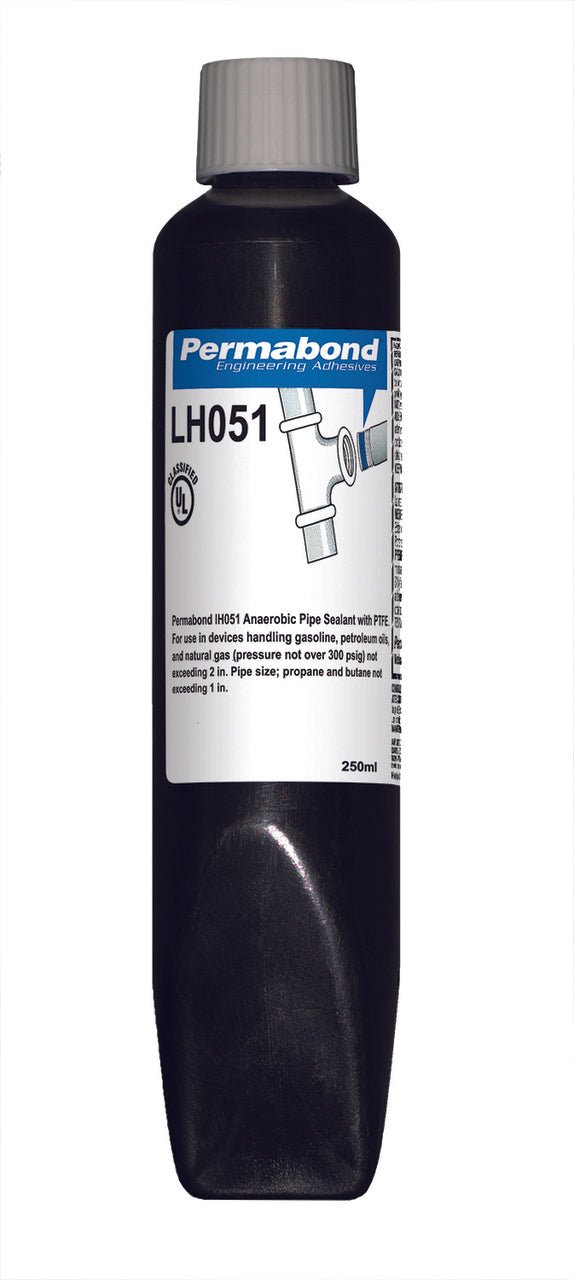
Permabond AA000510250T0101, LH051 Anaerobic Threadsealant, 250ml Tube, Case of 10
Permabond AA000510250T0101, LH051 Anaerobic Threadsealant, 250ml Tube, Case of 10
Permabond LH051 is a white, PTFE-containing anaerobic pipe sealant designed for applications requiring good bottoming-out of a metallic pipe, fitting or plug. Added lubricity helps seat components even with an interference fit, while its flowable formulation supports application with dispensing equipment. SKU AA000510250T0101 is supplied as ten 250 ml tubes.
Best Uses / Applications
- Threaded metallic joints requiring bottoming-out of pipes, fittings or plugs.
- Heavy-duty machinery, including compressors, hydraulic equipment and construction equipment.
- Dispensing-equipment processes requiring a flowable threadsealant.
- Qualified hydraulic systems where fine filler particle size matters for screens and valves.
Key Features
- PTFE-containing formulation provides added assembly lubricity.
- Fine filler particle size below 10 µm.
- Room-temperature anaerobic cure without solvents.
- Alternative to pipe dopes and pipe tapes that does not shred or tear like tape.
- Directional freedom within an appropriately designed threaded joint.
Important assembly caution: on soft brass parts, lubricity can be excessive and may cause deformation during assembly. Qualify the assembly process rather than relying on tightening feel alone.
Technical Specifications
Typical guideline values from Permabond LH051 Global TDS Revision 2, October 18, 2016. These are not an application specification.
| Property | Typical value / condition |
|---|---|
| SKU / grade | AA000510250T0101 / LH051 |
| Package | 250 ml tubes; case of 10 |
| Chemistry | Methacrylate esters with PTFE |
| Appearance | White |
| Viscosity at 25°C, 2 rpm | 450,000 mPa·s (cP) |
| Viscosity at 25°C, 20 rpm | 70,000 mPa·s (cP) |
| Specific gravity | 1.1 |
| Particle size | <10 µm |
| Maximum gap fill | 0.5 mm / 0.02 inch |
| Handling strength | 2 hours on M10 steel at 23°C |
| Full strength | 24 hours on M10 steel at 23°C |
| Breakaway torque, ISO 10964 | 4 N·m on M10 steel |
| Prevailing torque, ISO 10964 | 3 N·m on M10 steel |
| Shear strength, ISO 10123 | 7 MPa / 1,000 psi on steel collar and pin |
| Thermal conductivity | 0.19 W/(m·K) |
| Minimum cured exposure temperature | −55°C / −65°F, depending on bonded materials |
| Storage temperature | 5–25°C / 41–77°F |
Viscosity values must retain their measurement speed: 450,000 cP at 2 rpm and 70,000 cP at 20 rpm are not contradictory specifications. The thermal-expansion exponent was not reliably readable and is omitted. The TDS includes a hot-strength curve, but does not provide a single universal continuous-service upper-temperature rating in its text.
Cure & Pressure: Keep the Test Conditions Separate
Copper and its alloys accelerate cure, while oxidized or passivated surfaces such as stainless steel slow it. Lower temperatures and larger gaps extend curing. Consider Permabond A905, ASC10 or controlled heat with manufacturer guidance. The 2-hour handling and 24-hour full-strength values apply to M10 steel at 23°C, not every pipe joint.
The published 7 MPa / 1,000 psi value is a shear-strength result, not an immediate sealing-pressure rating. Do not use it to rate a pipe system. Likewise, the chemical-resistance tests below do not establish universal service limits. Validate the actual joint, medium, temperature, cure and operating pressure.
Published Chemical-Resistance Tests
The TDS reports no leakage after 1,000-hour immersion at 60 psi for each condition below. These are laboratory test conditions, not system ratings.
| Medium | Test temperature |
|---|---|
| 50% antifreeze / 50% water | 126°C / 260°F |
| Brake fluid | 150°C / 300°F |
| Differential lubricant | 150°C / 300°F |
| 5W/30 engine oil | 150°C / 300°F |
| Transmission fluid | 150°C / 300°F |
| Diesel fuel #2 | 25°C / 77°F |
| ASTM fuel C | 25°C / 77°F |
| Water / steam | 198°C / 390°F |
| Air | 150°C / 300°F |
Threadsealant Selection Comparison
| Selection consideration | LH051 | Other approach / grade |
|---|---|---|
| Bottoming-out and interference-fit seating | Specifically designed with added lubricity | Do not assume another grade has the same assembly behavior. |
| Dispensing equipment | Flowable formulation; validate equipment and process settings | Equipment suitability is not established by package size alone. |
| Soft brass | Excessive lubricity can cause assembly deformation | Qualify a suitable sealant and tightening process. |
| General-purpose pipe sealing | Prioritizes bottoming-out and dispensing characteristics | Evaluate standard LH050 under its own TDS. |
| Potable-water specification | Do not transfer PURE-grade documentation to LH051 | Evaluate LH050 PURE and its current listing conditions separately. |
Surface Preparation & Directions for Use
- Make metal threads clean, dry and grease-free. Use a suitable solvent-based cleaner such as acetone or isopropanol after checking surrounding-material compatibility.
- For inactive surfaces such as zinc, aluminum and stainless steel, consider A905 or ASC10 according to manufacturer instructions. Do not mix activator into the sealant.
- Prevent the dispensing tip from touching metal surfaces.
- Apply to the leading 3–4 male threads, halfway around pipes up to 1½ inches in diameter. For larger pipes, apply completely around.
- Screw fittings together and orient within the qualified joint design. Take special care with soft brass.
- Inspect for a bead around the entire circumference. If it is absent, repeat using more sealant.
- Allow sufficient cure for the actual metal, gap and temperature before service.
LH051 is designed for threaded metallic joints and is not recommended for plastic components. Do not use in contact with oxygen, oxygen-rich systems or strong oxidizers. It may adversely affect some thermoplastics. Follow the Safety Data Sheet and good industrial hygiene. For professional or industrial use only. Keep out of reach of children.
Manufacturer Application Video
The LH051 TDS links this general pipe-sealant directions video. Follow it alongside the grade-specific instructions and assembly cautions.
Watch Permabond's pipe-sealant directions on YouTube.
Technical & Safety Documents
Frequently Asked Questions
What is LH051 designed for?
Threaded metallic assemblies requiring good bottoming-out of pipes, fittings or plugs, including heavy-duty machinery applications.
Can LH051 be applied with dispensing equipment?
Yes. The manufacturer describes a flowable formulation for dispensing equipment. Validate the specific equipment, settings and application process.
Why are two viscosities listed?
The TDS gives 450,000 cP at 2 rpm and 70,000 cP at 20 rpm, both at 25°C. Retain the measurement speed when comparing values.
What is the soft-brass caution?
Added lubricity can be too high on soft brass and may cause deformation during assembly. Qualify the joint and tightening process.
Will the filler clog hydraulic screens?
The TDS states that the very small filler particle size allows use in most hydraulic systems without clogging screens or valves. Particle size is below 10 µm; confirm suitability for your system's filtration requirements.
How long does it take to cure?
Typical handling strength takes 2 hours and full strength 24 hours on M10 steel at 23°C. Actual metal, temperature and gap affect cure.
Is 1,000 psi an immediate pressure-seal rating?
No. In this TDS, 1,000 psi is the shear-strength result. It must not be treated as a pipe-system pressure rating.
Can LH051 be used on plastic pipe or in oxygen systems?
No. Plastic components are not recommended, and oxygen, oxygen-rich systems and strong oxidizers are excluded.
Does LH051 carry LH050 PURE's drinking-water documentation?
Do not transfer another grade's documentation to LH051. Evaluate current application-specific manufacturer documentation.
What is included in this listing?
SKU AA000510250T0101 includes ten 250 ml tubes of Permabond LH051. Store at 5–25°C.
Related Products & Resources
Browse the Permabond collection and explore the Adhesives, Dispensing & UV Cure Systems guide. For broader grade categories, see Permabond's thread-sealant selection guide; this does not replace the LH051 TDS.


