


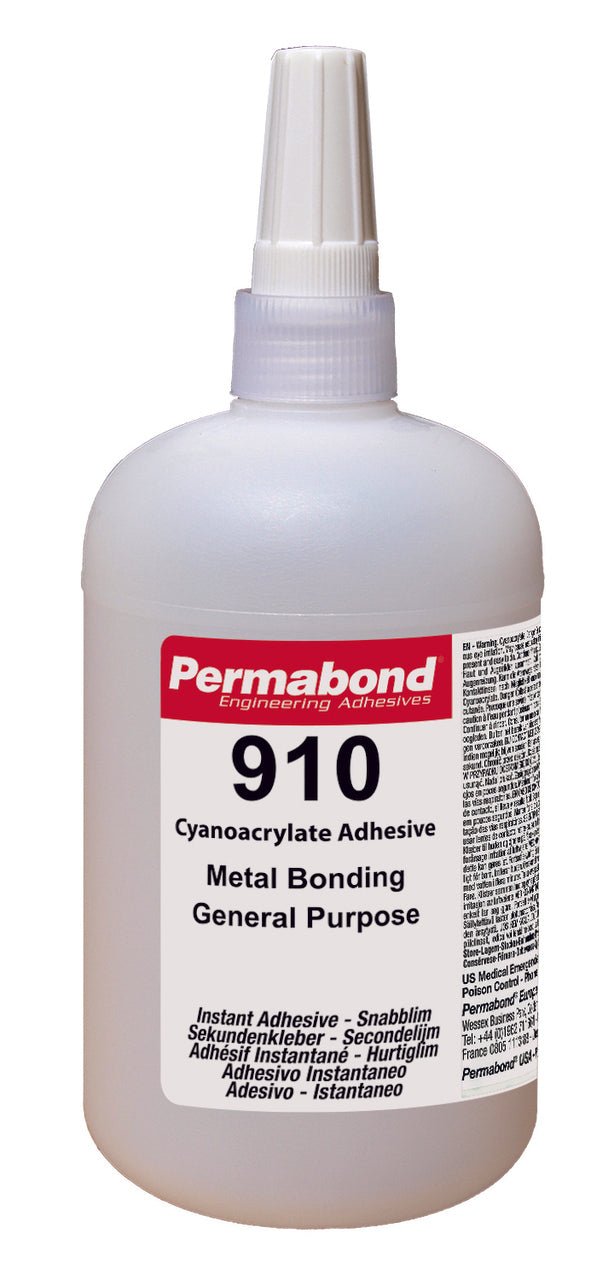
Permabond CA009100016Z0101, 910 1 Pound Bottle
Permabond CA009100016Z0101, 910 1 Pound Bottle
Permabond 910, ordering code CA009100016Z0101, is a single-component, low-viscosity methyl cyanoacrylate adhesive developed for close-fitting metal bonds. It cures rapidly at room temperature in a thin film between assembled parts and also adheres to many plastics and rubbers. This listing supplies one 1 lb bottle. Fixture strength is not full cure; qualify the actual substrate, gap and loading before production use.
Best Uses / Applications
- Close-fitting steel, aluminum and other metal assemblies.
- Metal-to-rubber or other dissimilar-material bonding after testing.
- Small-part production assembly and repair with controlled bondline thickness.
Key Features and Specifications
| Product / ordering code | Permabond 910 / CA009100016Z0101 |
|---|---|
| Chemistry | 100%-methyl cyanoacrylate adhesive; not ethyl cyanoacrylate |
| Format | One 1 lb bottle |
| Components | Single-part |
| Appearance | Colorless |
| Viscosity at 25°C | 70–90 mPa·s / cP |
| Specific gravity | 1.1 |
| Maximum gap fill | 0.15 mm / 0.006 in |
| Typical fixture/handling | 10–15 seconds on steel, Buna N rubber and phenolic in the manufacturer test |
| Full strength | 24 hours |
| Unopened storage | 2–7°C; allow to reach room temperature before opening |
Existing safety data sheet. Confirm applicability to the supplied product and region before use.
Technical Data Sheet
Download Permabond 910 Technical Data Sheet (PDF)
Selection Comparison
| 1 oz bottles, case of 10 | Smaller individual containers for distributed bench use. |
|---|---|
| 1 lb bottle | Larger container for an appropriate controlled dispensing process. |
| 910 versus other adhesive technologies | A thin-film instant adhesive is not a substitute for an independently qualified gap-filling, flexible or structural system. |
Frequently Asked Questions
Is Permabond 910 methyl or ethyl cyanoacrylate?
Permabond identifies 910 as the original 100%-methyl cyanoacrylate adhesive.
Does the fixture time mean the bond is fully cured?
No. The TDS lists typical 10–15-second fixture times for specified substrates and 24 hours to full strength. Actual results depend on conditions.
What gap can it fill?
The manufacturer lists a maximum of 0.15 mm. Close-fitting parts and process validation are important.
Does it require mixing?
No. It is single-component. Hold the parts in position as needed while fixture strength develops.
How should it be stored?
Store unopened containers at 2–7°C. Bring them to room temperature before opening to avoid condensation. Follow the product label and current manufacturer guidance for opened-container handling.
Is every plastic or rubber compatible?
No. Test the exact material and stress conditions. Do not assume suitability for low-surface-energy plastics, every chemical exposure or every temperature.


