


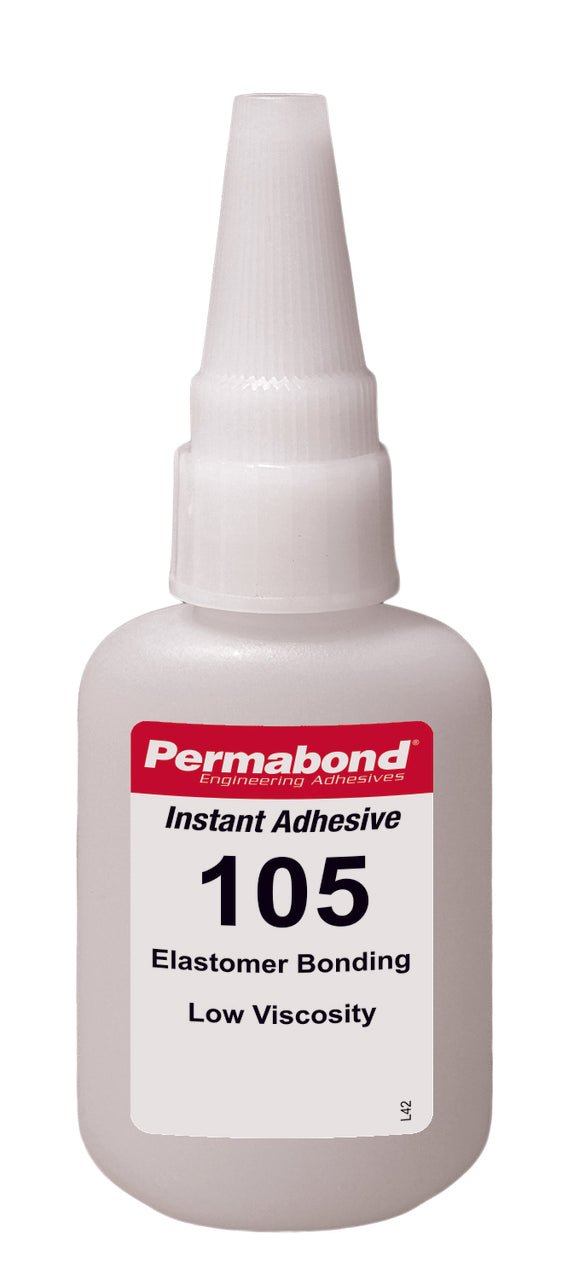
Permabond CA001050001Z0101 105 1 Ounce Bottle / Case of 10
Permabond CA001050001Z0101 105 1 Ounce Bottle / Case of 10
Permabond 105 is a low-viscosity, high-purity ethyl cyanoacrylate adhesive for fast bonding of tight-fitting parts. Supplied under SKU CA001050001Z0101 as a case of ten 1-ounce bottles, it develops rapid bonds to a variety of plastics, metals, natural rubber and synthetic rubbers. Its 30–50 cP viscosity makes it useful for thin bond lines, wicking and penetrating applications where a thicker adhesive would be difficult to distribute.
Best Uses / Applications
Consider Permabond 105 for high-speed assembly, tight-fitting plastic parts and natural or synthetic rubber bonding, including EPDM and butyl rubber. Its single-component chemistry suits production and repair tasks that benefit from rapid handling strength without mixing or heat cure. Validate the actual substrates, joint design and service conditions before production use.
Key Features
- Low viscosity: 30–50 mPa·s (cP) at 25°C.
- Single-component ethyl cyanoacrylate; 100% reactive and solvent-free.
- Surface moisture initiates cure when the adhesive is pressed into a thin film between parts.
- Typical handling times measured in seconds, depending on substrate and conditions.
- Maximum specified gap fill of 0.1 mm (0.004 in).
- Case of ten 1-ounce bottles; full strength develops in 24 hours.
Technical Specifications
| Specification | Detail |
|---|---|
| SKU | CA001050001Z0101 |
| Product | Permabond 105 |
| Package | 1-ounce bottle; case of 10 |
| Chemistry | Ethyl cyanoacrylate |
| Uncured appearance | Colorless |
| Viscosity at 25°C | 30–50 mPa·s (cP) |
| Specific gravity | 1.1 |
| Maximum gap fill | 0.1 mm / 0.004 in |
| Typical handling time, steel | 10–15 seconds |
| Typical handling time, Buna N rubber, phenolic, PVC and ABS | 5–10 seconds |
| Typical handling time, EPDM | Less than 20 seconds |
| Full strength | 24 hours |
| Typical steel shear strength, ISO 4587 | 18–22 N/mm² / 2,600–3,200 psi |
| Cured hardness, ISO 868 | 85 Shore D |
| Recommended storage | 2–7°C / 35–45°F |
| Technical reference | Global TDS Revision 7, September 13, 2025 |
Handling time is based on achieving 0.3 N/mm² shear strength, not full cure. Temperature, humidity, substrates, surface preparation and joint gap affect cure and performance. TDS values are typical guidance, not guaranteed performance for every joint.
Selection Guidance
| Application condition | How Permabond 105 fits |
|---|---|
| Tight-fitting parts and thin bond lines | Low viscosity and a 0.1 mm maximum gap make this a candidate for close-fitting joints. |
| Larger gaps or a non-running bead | Evaluate a higher-viscosity or gap-filling adhesive rather than assuming 105 will bridge the joint. |
| Rapid handling without mixing | Single-component moisture-initiated cure can provide handling strength within seconds. |
| Polypropylene, polyethylene, PTFE or silicone | The TDS directs users to prime first with Permabond Polyolefin Primer (POP). |
| Strong oxidizers or polar-solvent service | The TDS does not recommend this exposure; evaluate another adhesive for the actual service conditions. |
Surface Preparation, Use and Storage
Bonding surfaces should be clean, dry and grease-free. Use a suitable degreasing solvent compatible with the substrates. The TDS notes that aluminum, copper and their alloys may benefit from light abrasion to remove oxide layers.
- Apply adhesive sparingly to one surface.
- Bring components together quickly and correctly aligned.
- Apply enough pressure to spread the adhesive into a thin film.
- Do not disturb or realign the joint until sufficient handling strength develops.
- Allow 24 hours for full strength before evaluating final performance.
For difficult or porous surfaces, the manufacturer recommends an appropriate Permabond activator. Larger gaps and acidic surfaces can slow cure. Store at 2–7°C and allow the bottle to reach room temperature before opening to help prevent internal condensation and reduced shelf life. Review the Safety Datasheet before use. For professional or industrial use only; keep out of reach of children.
Manufacturer Application Videos
These general manufacturer guidance videos are referenced in the Permabond 105 Technical Datasheet. They supplement, rather than replace, the grade-specific written directions, TDS and Safety Datasheet.
Frequently Asked Questions
Is this one bottle or a case?
SKU CA001050001Z0101 is the case-of-10 listing, with ten 1-ounce bottles of Permabond 105.
Which materials is Permabond 105 intended to bond?
The manufacturer highlights hard-to-bond plastics and natural or synthetic rubbers, including EPDM and butyl rubber. The TDS also reports bond-strength results for metals and several plastics. Test the actual substrate combination before production.
How quickly does it cure?
Typical handling time is 10–15 seconds on steel, 5–10 seconds on Buna N rubber, phenolic, PVC and ABS, and less than 20 seconds on EPDM. Full strength takes 24 hours; handling time is not full cure.
Can it fill a large gap?
The TDS specifies a maximum gap fill of 0.1 mm (0.004 in). Evaluate another grade for larger gaps rather than exceeding this value.
Does it require mixing, heat or primer?
No mixing or heat cure is required. However, the TDS directs users to prime polypropylene, polyethylene, PTFE and silicone first with Permabond POP. Difficult or porous surfaces may require an activator.
How should the bottles be stored?
Store at 2–7°C (35–45°F). Allow adhesive to reach room temperature before opening the bottle to prevent condensation inside, which can reduce shelf life.
Technical & Safety Documents
Permabond 105 Technical Datasheet, Revision 7 (PDF)
Permabond 105 Safety Datasheet, existing hosted document (PDF)
Related Resources
Browse the Permabond collection and our Adhesives, Dispensing & UV Cure Systems guide for related adhesive-selection resources.


