

The Importance of Personal Grounding and the Proper Equipment
The Importance of Personal Grounding and the Proper Equipment
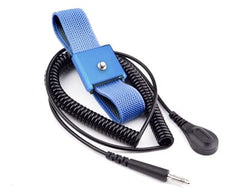
Personal grounding connects the human body to a common point ground, providing a controlled path for static charge to dissipate safely before it can discharge into an ESD-sensitive component. The human body is one of the primary sources of electrostatic charge in electronics assembly environments — walking across a floor can generate 250–35,000V depending on floor material and footwear, and a worker at a bench generates 700–6,000V through normal activity. Personal grounding devices — wrist straps for seated operators, heel or sole grounders for standing operators, and grounding mats for field service — are required elements of any ANSI/ESD S20.20-compliant ESD control program and must be verified at the start of every shift. For a complete ESD program guide, visit our ESD Program Essentials hub.
Personal Grounding Device Comparison
| Device | Best For | How It Works | Key Requirement |
|---|---|---|---|
| Wrist Straps (incl. coil cord sets and dual conductor sets) | Seated operators; primary grounding method for bench work | Conductive band contacts skin; coiled cord connects to common point ground; 1 MΩ series resistor limits current for operator safety | Test at start of every shift with a wrist strap tester; snug skin contact required for reliable resistance |
| Heel Grounders | Standing operators; assembly lines; warehouse and inspection areas | Conductive strap contacts skin at heel; conductive sole tab contacts ESD-safe flooring to complete the ground path | Requires ESD-safe flooring to complete the circuit; test with a person-to-ground resistance tester; wear on both feet |
| Sole Grounders | Standing operators requiring larger floor contact area | Covers entire shoe sole; larger contact area improves grounding consistency on ESD-safe floors | Same flooring requirement as heel grounders; verify resistance per ANSI/ESD S20.20 |
| Toe Grounders | Supplemental grounding at toe area; used with certain footwear types | Worn over toe area of shoe; provides additional dissipative path to ESD-safe floor | Requires ESD-safe flooring; used where heel grounders are impractical due to footwear design |
| Grounding Mats | Field service; portable workstations; areas without permanent ESD flooring | Conductive mat placed on floor or bench; operator grounds through mat via wrist strap or footwear contact | Must be bonded to ground; verify surface resistance and ground connection before use |
Frequently Asked Questions
Do I need both a wrist strap and heel grounders, or is one sufficient?
It depends on whether the operator is seated or standing. For seated bench work, a wrist strap connected to a common point ground is the primary and most reliable grounding method — it provides continuous, verified skin contact. For standing operators, heel or sole grounders are used because a wrist strap cord would restrict movement; however, they require ESD-safe flooring to complete the ground path. In some environments where operators alternate between sitting and standing, both may be required. ANSI/ESD S20.20 requires that the grounding method be appropriate for the task and verified at the start of each shift.
Why does a wrist strap have a 1 MΩ resistor in the cord?
The 1 megohm (1 MΩ) series resistor in the wrist strap cord limits the current that can flow through the operator’s body in the event of accidental contact with a live circuit. Without the resistor, a grounded wrist strap would create a low-resistance path to ground that could be lethal if the operator touched a live voltage source. The resistor limits current to a safe level while still providing sufficient conductivity to drain electrostatic charge from the body. This is why wrist strap resistance specifications have both a minimum (to ensure the resistor is present) and a maximum (to ensure the ground path is effective).
How do I test personal grounding devices and how often?
Wrist straps should be tested at the start of every shift using a dedicated wrist strap tester — test with the strap worn on the wrist, not held in the hand, to verify actual skin contact resistance. Heel and sole grounders should be tested with a person-to-ground resistance tester (operator stands on the tester plate while wearing the grounder) at the start of every shift. The acceptable resistance range per ANSI/ESD S20.20 for wrist straps is 750 kΩ to 35 MΩ (including the 1 MΩ resistor and body resistance). Document all test results — auditors will ask for them.
What happens if heel grounders are worn on non-ESD flooring?
Heel and sole grounders only work when the floor itself is ESD-safe (surface resistance within the ANSI/ESD S20.20 specification). On standard vinyl, concrete, or carpet, the floor acts as an insulator and the grounder provides no ground path — the operator is not grounded even though they are wearing the device. This is one of the most common ESD program gaps: facilities install heel grounders without verifying that their flooring meets ESD requirements. Always verify floor resistance before relying on footwear grounders as your primary grounding method.


