

Permabond Cyanoacrylate Adhesives
Permabond Cyanoacrylate Adhesives
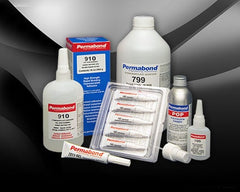
Permabond cyanoacrylate adhesives (instant adhesives) cure by reacting with trace moisture on substrate surfaces — no mixing, no ovens, no UV equipment required — with set times typically between 5 and 60 seconds depending on substrate and formulation. Permabond manufactures the original cyanoacrylate formulation (Permabond 910, formerly Eastman 910) and has since expanded to dozens of specialty grades covering metal, rubber, plastic, silicone, and composite bonding, with viscosities from wicking-grade to thixotropic no-flow gel, temperature resistance up to 250°C, and toughened grades for impact and peel resistance. For difficult substrates like polypropylene, polyethylene, and PTFE that standard cyanoacrylates cannot bond, Permabond offers surface-insensitive and specialty formulations. For a full overview of adhesive solutions, visit our Adhesives, Dispensing & UV Cure Systems hub.
Permabond Cyanoacrylate Grade Specifications
| Grade / Series | Key Property | Specifications | Best Application |
|---|---|---|---|
| 919, 920, 922 | High-Temperature Resistance | Up to 250°C (482°F) after secondary heat cure | Electronics, automotive, and industrial assemblies exposed to sustained high heat |
| 825 | Highest Temp Without Secondary Cure | 200°C (390°F) without secondary heat cure; patented technology | Applications where post-cure heat treatment is not feasible |
| 731, 735, 737 | Toughened — Impact & Peel Resistance | Enhanced flexibility and shear strength on rigid and flexible substrates; 735/737 opaque black, 731 crystal clear | Flexible substrates, rubber bonding, assemblies subject to vibration or impact |
| 940 Series | Non-Blooming, Low Odor | Virtually odor-free; no white residue around bond area; fast cure; high bond strength | Optical, cosmetic, and consumer electronics applications where appearance matters |
| Thixotropic Gel | No-Drip, Surface Insensitive | True thixotropic gel; bonds acidic substrates; stays in place on vertical surfaces | Wire tacking, tamper-proofing, vertical surface bonding, porous or acidic substrates |
| 2011 | NSF Non-Food Compound S4 | Gap-fill to 0.50 mm; −55 to +120°C; handling time <10 seconds; non-sag gel; bonds metal, plastic, elastomers, ceramics, wood | Food processing equipment, potable water applications, NSF-regulated environments |
Frequently Asked Questions
How do cyanoacrylate adhesives cure and what affects cure speed?
Cyanoacrylates cure by reacting with hydroxyl ions present in trace moisture on substrate surfaces — not with moisture in the air. Cure speed is affected by substrate type (metals and most plastics cure faster than acidic or very dry surfaces), ambient humidity (higher humidity accelerates surface cure), gap size (thinner gaps cure faster), and formulation. For applications where the adhesive is exposed rather than compressed between two surfaces — wire tacking, tamper-proofing — use a cyanoacrylate activator sprayed on the exposed adhesive to achieve an instant cure. Activators also help on very dry, acidic, or porous substrates where natural moisture is insufficient.
Can Permabond cyanoacrylates bond polypropylene, polyethylene, or PTFE?
Standard cyanoacrylates bond poorly to polyolefins (PP, PE) and PTFE because these surfaces have very low surface energy and minimal moisture. Permabond’s surface-insensitive and specialty formulations are engineered to overcome this — surface preparation with a primer or activator is typically required for polyolefins, and some formulations include built-in surface-insensitive chemistry. Contact our team with your specific substrate combination for a formulation recommendation before committing to a production process.
What is blooming and how do I prevent it?
Blooming is a fine white residue that forms around the bond area when cyanoacrylate vapors react with ambient moisture before reaching the substrate. It is primarily a cosmetic issue but can be a problem in optical or high-appearance applications. Permabond’s 940 series is specifically formulated to be non-blooming and virtually odor-free. To minimize blooming with standard grades: use the minimum amount of adhesive needed, avoid excess squeeze-out, ensure good ventilation, and do not apply adhesive in high-humidity conditions.
What is the temperature resistance of standard vs. high-temperature cyanoacrylate grades?
Standard cyanoacrylates typically withstand −55 to +80°C in continuous service. Permabond’s high-temperature grades (919, 920, 922) extend this to 250°C (482°F) after a secondary heat cure. Permabond 825 uses patented technology to achieve 200°C (390°F) resistance without any secondary cure — the highest temperature resistance available in a cyanoacrylate without post-cure processing. For applications above 250°C, consider Permabond’s structural epoxy or anaerobic product lines instead.


