

Let's Talk Finger Cots
Let’s Talk Finger Cots
Skin oils, salts, and particulates from bare hands are a leading cause of contamination on printed circuit boards (PCBs), bare wires, and sensitive electronic components. Oils on PCB pads and IC pins repel molten solder, causing poor wetting and unreliable joints. Skin salts and flakes introduce ionic contamination that can cause corrosion and leakage currents on analog circuits over time. ESD finger cots solve both problems simultaneously — they provide a barrier against skin contamination while dissipating or shielding static charge that would otherwise discharge into ESD-sensitive components. MTE Solutions carries finger cots from Botron and ACL Staticide in anti-static, dissipative, nitrile, and latex formats.
Finger Cot Types: Anti-Static vs. Dissipative vs. Nitrile vs. Latex
| Type | Material | ESD Properties | Best For |
|---|---|---|---|
| Anti-static (pink) | Latex or nitrile with anti-static treatment | Prevents triboelectric charge generation on the cot surface; surface resistance typically 10¹¹–10¹² Ω/sq | General PCB handling, component assembly, and inspection where charge generation prevention is the primary concern |
| Static-dissipative (black) | Latex or nitrile with dissipative treatment | Drains charge in a controlled manner; surface resistance typically 10⁶–10⁹ Ω/sq; provides more active ESD protection than anti-static | Handling ESD-sensitive components where controlled charge dissipation is required; mid-range static dissipation for more sensitive devices |
| Nitrile (anti-static) | Nitrile rubber with anti-static treatment | Anti-static; latex-free | Facilities with latex allergy policies; chemical-resistant applications; nitrile resists many solvents and chemicals that would degrade latex |
| Latex (anti-static or dissipative) | Natural latex rubber | Anti-static (pink) or dissipative (black); inherent elasticity for comfortable fit | General electronics assembly and PCB handling; economical option for high-volume use; washed and powder-free |
Botron and ACL Staticide Finger Cots at MTE Solutions
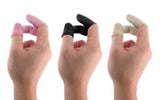
Botron offers three finger cot types — anti-static (pink), dissipative (black), and cleanroom-safe — all designed to protect electronic components from skin salts, flakes, oils, and other particulates. Available in Small, Medium, Large, and XL. Key Botron options at MTE Solutions:
- Botron B6845 Pink Anti-Static Finger Cots, Small (10 Gross)
- Botron B6842 Black Dissipative Finger Cots, Medium (5 Gross)
- Browse all Botron finger cots →

ACL Staticide offers anti-static powder-free nitrile and latex finger cots in multiple colors and sizes. Key ACL Staticide options:
- Nitrile (latex-free): ACL 90NI White Anti-Static Nitrile Finger Cots — chemical-resistant; suitable for facilities with latex allergy policies
- Pink latex (anti-static): ACL 70LA Pink Anti-Static Latex Finger Cots — economical; washed and powder-free; comfortable fit
- Black latex (dissipative): ACL 80LA Black Static-Dissipative Latex Finger Cots — mid-range static dissipation for more sensitive applications
- Browse all ACL Staticide finger cots →

Frequently Asked Questions
Why do skin oils cause problems on PCBs and solder joints?
Skin oils are hydrophobic and create a thin film on metal surfaces that repels molten solder — the solder beads up rather than wetting the pad or pin, resulting in a cold joint, insufficient joint, or no joint at all. On analog circuits, skin oils and salts introduce ionic contamination that can create leakage paths between conductors, causing signal integrity issues, increased noise, and long-term corrosion. Finger cots eliminate direct skin contact with PCBs, pads, pins, and bare wires, preventing these contamination mechanisms entirely.
When should I use dissipative (black) finger cots vs. anti-static (pink) finger cots?
Anti-static finger cots (pink) prevent charge generation on the cot surface — they are appropriate for general PCB handling and assembly where the primary concern is preventing triboelectric charge buildup. Dissipative finger cots (black) actively drain charge in a controlled manner through the cot material — they provide more active ESD protection and are preferred for handling highly ESD-sensitive components (ESDS devices with low withstand voltage) or in processes where the operator may accumulate charge that needs to be dissipated through the fingertip contact point. For most electronics assembly, anti-static finger cots are sufficient; for handling the most sensitive devices, dissipative finger cots provide an additional margin of protection.
Are nitrile finger cots better than latex for electronics work?
Neither is universally better — the choice depends on your facility requirements. Nitrile finger cots are latex-free (essential for facilities with latex allergy policies), chemically resistant to many solvents and cleaning agents, and do not degrade under chemical contact. Latex finger cots have inherent elasticity that provides a more comfortable, conforming fit and are typically more economical for high-volume use. Both are available in anti-static and dissipative formulations. If your facility has a latex-free policy or operators work with solvents, choose nitrile. For general electronics assembly without chemical exposure, latex is a cost-effective choice.
What size finger cot should I order?
Finger cots are sized by finger diameter — Small, Medium, Large, and XL. A properly sized finger cot should fit snugly without restricting circulation or slipping off during use. Most adults use Medium or Large; Small is appropriate for smaller hands or for use on specific fingers (index, thumb) rather than all fingers. When ordering for a facility, stock Medium and Large as the primary sizes and Small and XL for operators who need them. Finger cots are sold in bulk (gross quantities) — order based on your daily usage rate and desired reorder frequency.
Shop Botron Finger Cots → | Shop ACL Staticide Finger Cots →


